AI and Jobs in France: What Karpathy's Map Reveals About Our Economic Future

AI and Jobs in France: What Karpathy's Map Reveals About Our Economic Future
By Ludovic Goutel, Founder, Orchestra Intelligence
---
"Yeah, it's not gonna change the wheel on my truck."
That's what a friend told me when I was telling him about the latest feats of artificial intelligence. And honestly? He's right.
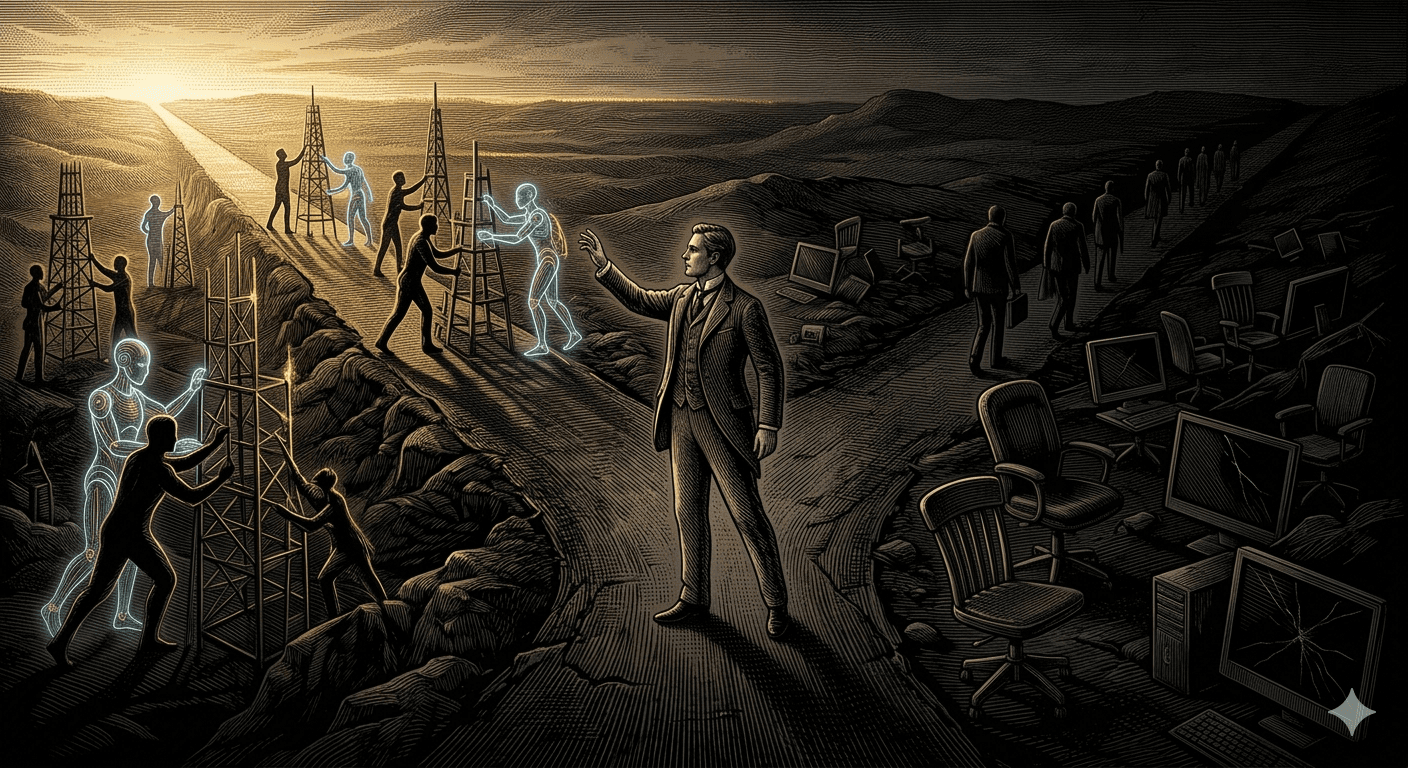
His interactive map of 342 occupations reveals a future closer than we think. But this map tells a much bigger story than a blue-collar comeback. It raises a question that concerns every leader, every worker in France, and one that many prefer not to answer.
---
Who Is Karpathy, and Why You Should Listen
Former Director of AI at Tesla. Co-founder of OpenAI. Creator of Stanford's CS231n. Founder of Eureka Labs.
When someone with this track record publishes a tool mapping AI's impact on 342 occupations representing 143 million jobs, it's not a gimmick. It's a signal. And France hasn't received that signal yet.
---
The US Job Market Visualizer
Each occupation is represented as a rectangle whose area is proportional to total employment. Software developers get a small rectangle. Truck drivers get a massive one. At a glance, you see the true weight of each profession, not the one you imagine.
Then, a color layer: the AI exposure score, rated 0 to 10.
We translated and adapted it into French.
- 0-3: physical jobs, unpredictable environments. Roofers, electricians, firefighters. AI does almost nothing here.
- 4-5: mixed jobs. Nurses, police officers, veterinarians. AI assists, humans remain essential.
- 6-7: knowledge work with judgment and relationships. Teachers, managers, accountants.
- 8-9: almost entirely screen-based work. Developers, designers, translators, analysts.
- 10: routine information processing. Data entry, telemarketing.
The underlying rule is simple: any job that can be performed entirely from a computer faces structurally high exposure. That's precisely where AI is advancing fastest.
---
What Karpathy Does NOT Say
This is the most important nuance, and the most ignored.
Karpathy himself warns:
> "A high score does not predict the job will disappear. Software developers score 9/10 because AI is transforming their work, but demand for software could easily grow as each developer becomes more productive."
A high score doesn't mean elimination. It means transformation. If each developer becomes 3x more productive, projects that were too expensive suddenly become viable. Demand isn't fixed, it's elastic.
The scores also ignore latent demand, regulatory barriers, and social preferences. It's an exploration tool. Not a prophecy.
---
French Transposition
The data covers the American market. But our developers, accountants, and translators do the same work as their American counterparts. AI exposure is structural, not geographical.
What differs is the context in which this transformation arrives.
France has one of the highest labor costs in Europe. For 60,000 euros in employer cost, the employee takes home about 36,000 euros. This ratio creates permanent pressure, and a predictable reflex: when technology enables doing the same thing with fewer people, the temptation to cut is immense. Because each position is expensive.
That's exactly where the danger lies. Not in AI. In the human decision that follows.
---
AI Doesn't Replace Jobs. Leaders Do.
AI has never fired anyone. Human beings make those decisions.
When facing an AI that can assist an accountant, two options:
Option A: cut 30% of positions, maintain output, pocket the margin. Immediate positive result. Three-year result: loss of expertise, organizational fragility, technological dependency.
Option B: keep the teams, augment them with AI, capture productivity as growth. A firm handling 200 cases can suddenly handle 500.
Option B is harder. That's why most don't choose it.
A CEO who uses AI to cut headcount is optimizing a spreadsheet. A CEO who uses AI so every employee spends 90% of their time on high-value work, that person understood something fundamental.
---
France's Optimal Scenario
France faces a unique convergence: massive productivity gains made possible by AI, labor costs among the highest in Europe, and colossal latent demand, thousands of companies with unrealized projects due to lack of resources.
The winning scenario: strong AI adoption + active team reskilling + temporary charge relief to offset transition costs. Not to subsidize inaction, but to reward those who bet on their teams rather than against them.
Will it happen? I hope so. The alternative is 5 years behind. And 5 years in AI is an eternity.
---
Sovereignty Is at Stake Right Now
The most powerful AI models are American or Chinese. Cloud infrastructure is American. GPUs come from NVIDIA, manufactured in Taiwan.
France has Mistral. A remarkable start. But sovereignty isn't just about producing models. It's about the ability of French businesses to use AI strategically. A country whose SMEs master these tools, even with foreign models, is more sovereign than a country with its own model but where 80% of leaders think "AI is for big corporations."
This competence is built now. Not in 5 years.
---
Intellectual Honesty
This analysis is not original research by Orchestra Intelligence. We took Karpathy's tool, which hasn't yet circulated in the French ecosystem, and translated, contextualized, and analyzed it. The scores are LLM estimates, as Karpathy himself specifies. Directional indicators, not rigorous predictions.
Our contribution is in the analysis: the French transposition, the social charges angle, and the conviction that the response to AI is neither panic nor inaction. It's informed action.
---
Explore the Map
We translated Karpathy's tool into French.
The map is a mirror. What you see in it depends on what you choose to do with it.
Want to understand where your company stands facing AI? Let's talk.
Let's discuss your situation →
---
Ludovic Goutel, Founder, Orchestra Intelligence
Clear, Useful, and Human AI.
Sources: US Job Market Visualizer, Andrej Karpathy · Bureau of Labor Statistics · Occupational Outlook Handbook

Ludovic Goutel
Artificial Intelligence and Strategy Expert at Orchestra Intelligence.
Read next.
AI Agents for Pet Stores and Pet Care: Stock Management, Personalized Advice, Customer Loyalty and Omnichannel in 2026
The pet care market in France exceeds 6 billion euros in 2026, with 79 million pets and average annual spending of 943 euros per animal for young professionals. Pet store chains (Maxi Zoo 350+ stores, Animalis 60+, Tom&Co) and DNVBs (Ultra Premium Direct, Edgar & Cooper) face growing competition. AI agents automate perishable stock management, multi-species nutritional advice, customer loyalty and omnichannel coordination.
AI Agents for Intellectual Property: Patent Firms, Prior Art Search, Deadline Management, International Filing and Freedom-to-Operate Analysis in 2026
16,807 patent applications filed at INPI in 2025 (+8.7%), 103,645 trademark applications (+14.1%), nearly 1,200 registered patent attorneys in France and firms like Plasseraud IP (400 employees), Regimbeau, Lavoix and Novagraaf handling thousands of cases annually. AI agents automate technology monitoring, prior art search, deadline management, international filing coordination and freedom-to-operate analysis for IP firms and corporate IP departments.
AI Agents for Optical Retail and Optician Networks: Third-Party Payment Management, Virtual Try-On, Lens and Frame Inventory, Insurance Follow-Ups and Appointment Booking in 2026
EUR 8.1 billion in revenue, 13,300 retail locations, 53% franchise-affiliated and a 76% corrective lens adoption rate among adults over 20. The French optical market is the densest in Europe. AI agents automate third-party payment processing, insurance claim follow-ups, lens and frame inventory rotation, appointment scheduling and virtual try-on for independent opticians and major retail networks alike.